
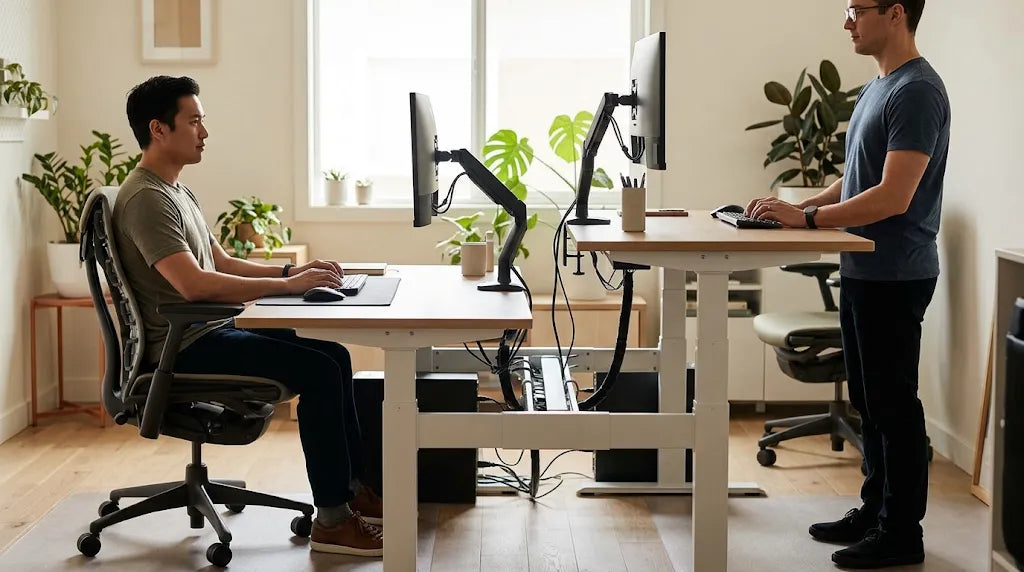
Most desks sold in Australia sit at a fixed height of around 72 to 76 cm. That number is a manufacturing average, not a measurement of you. If you are shorter or taller than the person that average was built for, the standard desk height is the reason your shoulders ache at 4pm.
This guide explains what the standard desk height actually is, how to work out the right height for your body, and what to do when your desk cannot be adjusted.
What Is the Standard Desk Height?
In Australia and most of Europe, a standard fixed desk is 72 to 76 cm high. In the United States the same figure is expressed as 29 to 30 inches. Almost every mass produced office desk, study desk and kitchen bench follows this range.
The range exists because it suits a person of roughly average height, around 175 cm. Sit someone of 160 cm at that desk and their elbows sit below the desk surface, so they slump or raise their shoulders to reach the keyboard. Sit someone of 190 cm at the same desk and they fold their legs or sit too far back to use the keyboard properly. Safe Work Australia's workstation setup guidance makes the same point: the desk has to fit the person, not the other way around.
The Right Desk Height for Your Body
Forget the average. Use these two checks instead.
-
Seated: your elbows should rest at roughly 90 degrees, forearms level with the floor, when your hands are on the keyboard. Your desk surface should be at, or just below, elbow height.
-
Standing: your elbows should sit at the same 90 degrees with relaxed shoulders. A standing desk surface usually lands around 100 to 110 cm for an average height adult, but the elbow test still decides it.
As a rough starting point by height:
-
Under 160 cm: seated desk around 66 to 70 cm
-
160 to 175 cm: seated desk around 70 to 73 cm
-
175 to 188 cm: seated desk around 73 to 76 cm
-
Over 188 cm: seated desk around 76 to 80 cm
Treat these as starting points and adjust by feel. The elbow test is the final word, because leg length and torso length vary as much as total height does.
Why "One Height Fits All" Fails
A fixed desk cannot be right for everyone in a household or office. The usual workarounds (a higher chair, a footrest, a stack of books under the monitor) patch the symptom rather than the cause.
Raising the chair to fix elbow height lifts the feet off the floor, so you need a footrest. Raising the monitor with books works, but the stack is never quite level and rarely survives a tidy up. Each fix adds an object to the desk and still leaves you compensating.
How to Fix a Desk That Is the Wrong Height
There are three practical routes, in order of how much they change the setup.
1. Adjust the chair and add a footrest
The cheapest option. Set your chair so your elbows sit at 90 degrees, then add a footrest if your feet no longer reach the floor. This gets the body right but leaves the desk exactly where it was, so tall users still end up with a desk that is too low. A sit stand chair is worth considering if you want one seat that works at both heights.
2. Use a standing desk converter
A standing desk converter sits on top of your existing desk and raises your keyboard and monitor together to a standing height. It keeps your current desk, adds a standing option, and takes minutes to set up. This is the usual fix where the desk itself cannot be replaced, such as a rented office, a shared desk, or a home study built into joinery.
The trade off is depth. A converter eats into the usable desk area, so check that your monitor, keyboard and mouse all still fit comfortably once it is in place.
3. Replace the desk with an adjustable one
An electric standing desk solves the problem at the source: it moves to your seated height, your standing height, and everyone else's in between. It is the only option that suits more than one person sharing a workspace, and the only one that makes switching between sitting and standing a single button job rather than a reorganisation. If you are weighing up whether the change is worth it, our guide to the benefits of a standing desk covers what you actually gain day to day. Our full range of sit stand desks includes electric, mobile and compact options, and power accessories such as under desk cable trays and power boards keep the cables tidy so the height you set is the height you actually use.
Getting the Monitor Right, Not Just the Desk
Desk height is only half of the setup. Your monitor height matters just as much, and it is the part most people never adjust.
-
The top of the screen should sit at, or slightly below, eye level.
-
The screen should be roughly an arm's length away, about 50 to 70 cm.
-
The screen should be square to your face, not angled off to one side.
A monitor sitting on its own base is usually too low, because the base is designed for a desk height that may not match your chair and torso. A monitor arm or monitor mount lets you lift the screen to eye level and pull it closer, which is what actually removes the neck strain. Where the desk is shared or the surface is already crowded, a monitor arm also frees the desk surface for the keyboard. If you are already changing your desk setup, fixing monitor height at the same time costs very little extra effort and makes the biggest difference to how the setup feels by the end of the day.
Quick Checklist
-
Measure your current desk. If it is 72 to 76 cm, it is a standard fixed desk.
-
Sit down, put your hands on the keyboard and check your elbows. Level with the floor and at 90 degrees? The height is right for you.
-
Feet flat on the floor, or on a footrest if the chair had to go up.
-
Top of the screen at or just below eye level, an arm's length away.
-
If the desk is wrong and cannot move, choose a fix: footrest and chair adjustment, a standing desk converter, or an adjustable desk. Safe Work Australia's guidance on sitting and standing is a useful reference if you want to vary your posture through the day.
The standard desk height is a useful starting point, not a rule. The right height is the one that puts your elbows at 90 degrees and your screen at eye level, whatever number that turns out to be.
Share:
Standing Desk Height: How High Should a Standing Desk Be?